

An IV won’t make you lose weight. There is no fat-burning drip: an IV doesn’t burn fat or replace eating for your goal, training and sleep, and there is no FDA-approved “weight-loss IV.” Thinking about a weight-loss plan? Talk to your doctor first.
Where IV therapy can fit
Plateaus happen. Fatigue creeps in, recovery lags, travel throws off your hydration, motivation dips. A drip can play a supporting role there: not as a shortcut, but by backing your hydration, energy and recovery so it’s easier to stay consistent with the habits that actually change things.
A visit is simple and clinical. You answer a quick health screen (history, medications, allergies, goals) and the nurse checks your vitals. If a drip suits you, a registered nurse places a small IV with sterile technique and starts it; it runs for about 30 to 40 minutes with comfort and rate checks. Then the IV comes out, the spot is bandaged, and you get simple aftercare.
What a drip can support
1. Hydration and electrolytes
Even mild dehydration makes effort feel harder, slows recovery and can bring on headaches that knock you off schedule. Replacing fluids and electrolytes supports circulation, temperature control and the nerves and muscles you’re training, so long sessions, hot days and flights feel more manageable. That’s what Hydration is for. (Drink mixes like Liquid I.V. help with everyday hydration too, but a drink isn’t an IV, and neither one causes weight loss by itself.)
2. Energy (B-complex and B12)
B vitamins help turn food into usable energy in your cells. When you’re eating less, or not absorbing enough, fatigue and brain fog can derail meal prep, your steps and gym time. Topping up B-complex and B12 supports normal energy metabolism and may ease that “diet drag”; it’s most noticeable if you were running low to begin with. They’re in Energy & Focus, or as add-ons to any drip.
3. Recovery (magnesium and electrolytes)
Recovery drives consistency. Magnesium takes part in hundreds of reactions tied to muscle and nerve function, and may help with exercise cramps and soreness; better sleep often follows. Together with electrolytes, it can help you arrive at the next session with fresher legs and steadier focus.
4. Antioxidants (vitamin C and glutathione)
Hard training and eating less can leave you feeling run down. Vitamin C supports the immune system and connective tissue, useful when training goes up or you’re back from travel or illness. Glutathione is an antioxidant inside your cells that supports their defenses and recovery: a wellness aid, never a fat burner.
What about “metabolism” add-ons?
You may see “lipotropic” add-ons like MIC or L-carnitine sold for metabolism. Any effect is modest, and only alongside eating for your goal and training consistently; they aren’t on our menu. NAD+ is central to how cells make energy, and is best thought of for energy and recovery, not weight loss. Everyone responds differently.
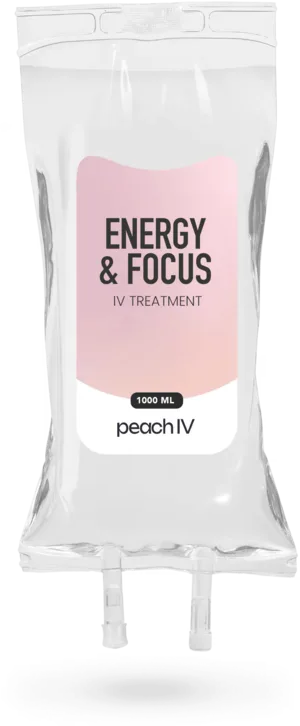
Energy & Focus, from $295: fluids with B12, B-complex and glutathione, brought to your home, hotel or office by a registered nurse. No travel fee. No service charge.
Side effects and risks
Given properly in a clean setting, IV therapy is generally well tolerated. It still involves a needle, a vein and concentrated nutrients, so know the difference between the likely and the rare.
Common, usually mild
- Bruising, tenderness or vein irritation where the IV went in. These usually settle once the IV is out.
- Infiltration. If the catheter shifts, fluid can leak into the tissue around it; removing it and simple care usually fix it.
- Lightheadedness, flushing, a brief headache or nausea. Often from the drip running fast: slowing it down usually helps. NAD+ especially can cause these if it runs too quickly.
Less common or serious
- Infection, local or in the bloodstream. Uncommon with proper sterile technique.
- Air embolism or a collapsed vein. Rare complications of the procedure, which is why trained staff and monitoring matter.
- Fluid overload or an electrolyte imbalance. Higher risk with heart or kidney disease, or with diuretics or ACE inhibitors. Dose and rate matter: magnesium given too fast can cause flushing or low blood pressure.
- Allergic reactions. Severe reactions are rare, but have been reported with IV vitamins.
- Repeated high doses. High-dose vitamin C can raise oxalate in the urine (extra caution with kidney disease or kidney stones) and can harm red blood cells in people with G6PD deficiency, and too much zinc over time can lead to low copper.
More in IV therapy safety and side effects.
Talk to your doctor first if…
- you have heart failure or significant kidney disease: extra fluid and electrolytes can strain these organs
- you have a severe electrolyte imbalance or uncontrolled blood pressure
- you’re pregnant or breastfeeding: talk to your doctor or midwife first
- you have an active infection, a fever, or a skin infection where the IV would go
- you’re allergic to any IV ingredient or preservative
- you have G6PD deficiency or a history of kidney stones and are considering high-dose vitamin C
- you take higher-risk medicines: diuretics, ACE inhibitors, lithium, blood thinners, chemotherapy, or long-term high-dose zinc
How we approach it
Our nurses come to your home, office or hotel, so a drip can fit around a heavy training week, a long flight or a plateau, supporting your plan, never replacing it. Every visit starts with a health screen, a registered nurse places the IV with sterile technique, and you’re watched throughout. If a drip isn’t the right move that day, we’ll tell you.

With 10+ years of experience in the medical field, he designs and supervises protocols to keep care safe, consistent, and clinically grounded.