

How Does IV Drip Work? The Science Behind IV Therapy

December 4, 2025
•
7 min read

How exactly does an IV drip work? How does a simple IVrehydrate you faster than drinking water? In this article, we break down the science of how an IV works, from the physics to the physiology.

New to IV treatments? Be sure to check out our comprehensive IV Therapy Guide for a complete overview of IV therapy benefits, risks, and how it works before diving into the details below.

‍

Table of Contents (scroll)
Table of Contents

Introduction

IV drips have exploded in popularity in recent years but you’ve probably wondered – just how do they work? In this article, we break it down into two components:

  1. The physics of an IV drip itself
  2. How the direct infusion of fluids and nutrients can benefit the body.

How Does an IV Drip Work?

Let’s start by explaining the physics of an IV drip, starting with gravity

Gravity and Hydrostatic Pressure

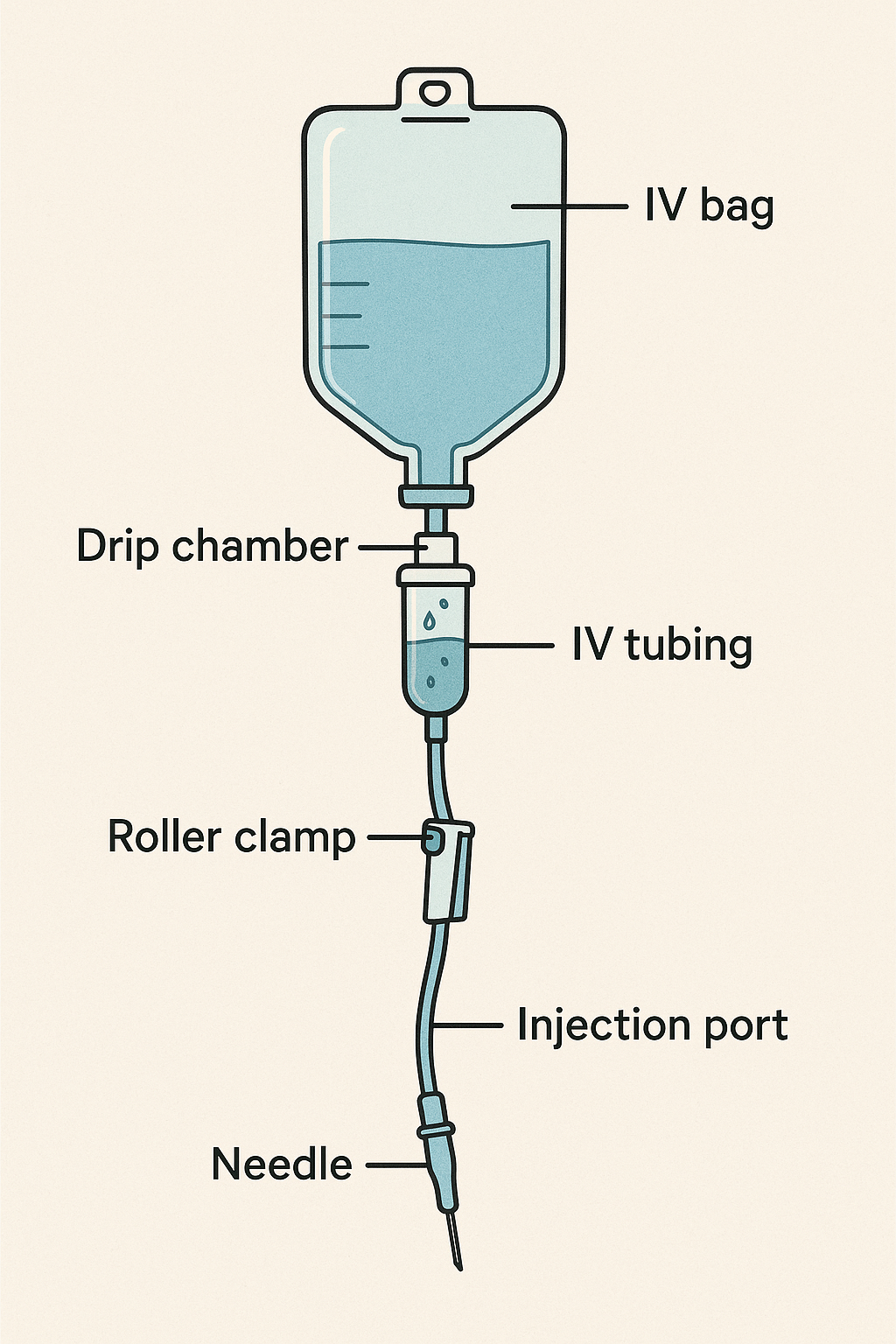
Have you wondered why an IV drip needs to be hung on a pole so high above the body? It's because an IV drip works primarily through gravity.  The IV fluid (usually in a bag or bottle) is hung on a pole above the patient’s body (or IV insertion site),creating a height difference that generates hydrostatic pressure.  

Because the fluid in the bag is elevated, gravity creates apressure that pushes the fluid down through the IV tubing and into the patient’sveins.  The higher the IV bag is hung,the higher the pressure is generated and the faster the fluid will flow.

If you’ve ever received an IV drip, you might have noticedtimes when you stand up, or when the bag is unexpectedly lowered, the IV dripwill either slow down, or blood will back up into the tubing - this is becausethe of the drop in pressure.

Tubing Diameter and Flow Rate

The rate of fluid flow in an IV is heavily determined by thewidth and length of the tubing and catheter. Poiseuille’s law states that theflow rate increases with a larger tube radius. Most tubing sizes are standardized and the rate limiting factor to the flow of an IV is determined by the smallest width of the entire setup, which comes down to the catheter (the little part that inserts into the vein).

Sizing of IV catheters may be a little confusing, but a larger number correlates to a smaller radius - so a 18-gauge IV catheter isactually bigger than  a 22-gauge catheter. In practical terms, a wider IV catheter allows a much faster flow, so that 18-gauge IV catheter will allow a much faster IV flow than the 22-gauge catheter under the same pressure. Conversely, flow rate is inversely proportional to the length of the tubing, meaning longer lines or catheters will reduce the drip rate.

The viscosity (thickness) of the IV fluid also matters: thin fluids like saline drip more easily, whereas thicker solutions (for example, blood or certain medications) flow more slowly due to greater resistance.

Flow Control Devices: Drip Chamber, Clamps, and Filters

An IV administration set includes a few simple devices that regulatethe flow of fluid

Just below the IV bag is the drip chamber, where the IV set gets its iconic nickname. It is a clear plastic chamber where fluid drips form visible drops.  This serves two important functions – it allows healthcare providers to see and count the drops to gauge the drip rate, and it helps prevent air bubbles from traveling down the line bytrapping any air at the top of the chamber.

Farther along the tubing is a roller clamp, which can pinch the soft tubing to control the flow rate. It is similar to a dimmer switch for the IV drip and gives fine control to the provider to adjust how fast the patient receives fluids.

Connected along the tubing is a roller clamp, which is a small adjustable clamp that pinches the soft tubing. By sliding the rollerclamp, the tubing’s internal opening can be partially narrowed or widened,thereby controlling the flow rate. Tightening the clamp slows or even stops the drip, while loosening it lets fluid flow. In this way, the roller clampacts like a dimmer switch for the IV drip, giving fine control over how fast the patient receives fluid.

How Does IV Drip Help?

We’ve explained how an IV drip set functions, but how does that fluid work to make you feel better after it is delivered into the vein?

Rapid Hydration and Blood Volume Expansion

Delivering fluid directly into a vein allows for rapid hydration and expansion of blood volume. When an IV drip of isotonic solution (same salinity as blood plasma) is started, the incoming fluid immediately increases the volume of circulating blood in the circulatory system.  This ensures there is sufficient fluid to maintain a healthy blood pressure and perfusion to the organs of the body,while flooding the tissues with isotonic hydration.  An IV not only quickly restores optimal fluid volume, it adds volume without disrupting the body’s electrolyte balance and is used optimally by the cells of the body.

Cellular Exchange and Electrolyte Balance

IV fluids like normal saline (0.9% NaCl) and lactated Ringer not only hydrate but support the optimal environment for cells to function.  The fluids closely mimic the body’s natural electrolyte homeostatis, and by infusing this balanced fluid full of electrolytes, the normal balance of salts and fluids is maintained while expanding the overall volume of fluid.

An isotonic IV saline solution provides sodium and water in a proportion that the body recognizes as normal, and will increase overall extracellular fluid volume, which also enhances the exchange of nutrients andwastes at the cellular level.

Meanwhile, the electrolytes in the IV help ensure that nerve impulses, muscle contractions, and other cellular processes that depend on ions continue to function properly.  This may explain why people feel so refreshed and energized not only immediately after the IV, but for 1-3 days after the IV is completed.

Conclusion

An IV drip is simple physics serving clear physiology. Elevating the bag creates hydrostatic pressure, while tubing width, length, and viscosity set the flow. The drip chamber and roller clamp fine tune delivery so fluid enters the vein at a controlled rate.

Once in the bloodstream, isotonic fluids expand circulating volume fast which supports blood pressure and organ perfusion, restores electrolyte balance, and helps cells fire nerves, contract muscle, and exchange nutrients and waste efficiently. That is why many people feel clearer,steadier, and more energized soon after an infusion and sometimes for a day or two beyond.

When IV therapy is provided by trained professionals in a clean setting, the procedure is generally safe and predictable.

FAQs

How does IV hydration work compared to drinking water?

IV hydration sends fluid directly into your bloodstream, so your body can use it right away. Drinking relies on gut absorption, which is slower and can be limited by nausea or illness.

What are the real benefits of a vitamin drip for healthy adults?

The main proven benefit is rapid hydration and electrolyte balance. If you do not have a deficiency, extra vitamins are usually filtered out. Effects vary person to person.

When is intravenous therapy used in medical care?

Doctors use IVs for dehydration, antibiotics, pain or nausea meds, surgery support, and blood products. It is chosen when fast or reliable delivery is needed or oral intake is not possible.

Is hydration infusion therapy safe?

Yes, when done by trained clinicians in a clean setting with screening. Common minor effects are a brief pinch, bruising, or site soreness. Serious complications are uncommon.

How does IV therapy help the body after heavy exercise or a hangover?

It restores fluid and electrolytes quickly, which can reduce headache, dizziness, and fatigue. It does not replace sleep, nutrition, or ongoing oral hydration.

Written By:
Dr Austin S.
Dr. Austin Shuxiao is a board-certified Internal Medicine physician and founder of Peach IV. With decades of clinical experience, he blends evidence-based medicine with a deep understanding of holistic care to deliver elevated, results-driven wellness solutions.
Share this post

Ready to take control of your hydration and health?

Book an IV therapy visit with a licensed clinician. We will review your goals and health history, recommend the right drip, and deliver safe, controlled hydration with clear dosing. Most appointments take 45 to 60 minutes, with quick screening and easy scheduling. Choose in home or in clinic service and get straightforward guidance on what to expect before, during, and after your infusion. Reserve your spot now and start feeling the difference.

Sign up for our newsletter

Get weekly updates on all things IV therapy

By clicking Sign Up you're confirming that you agree with our Terms and Conditions.
Thank you! Your submission has been received!
Oops! Something went wrong while submitting the form.