

Why NAD+ matters for energy
In our fast-paced world, finding your focus and energy can be a daily struggle; fatigue and brain fog are among the most searched topics on the internet. NAD+ therapy is a newer player on the scene.
NAD+ (nicotinamide adenine dinucleotide) isn’t a stimulant like caffeine. It’s a naturally occurring molecule, fundamental to how your cells produce energy. You’ve probably heard of ATP, the energy your cells run on: NAD+ is part of the machinery that makes it. Here is how that works, in the body and in the brain.
What is NAD+, and why an IV?
NAD+ exists in two forms, NAD+ and NADH, which cycle through your metabolism to move energy around the body (more in NAD+ vs NADH). NAD+ levels naturally decline as we age, and stress, poor diet and toxins can lower them further.
NAD+ IV therapy delivers NAD+ directly into your bloodstream: a sterile solution drips slowly through an IV line into a vein, skipping digestion. Much of what you swallow is broken down in the gut, which is why some people choose a drip.
Sessions last 1 to 4 hours, depending on the dose and how you feel. Commonly reported side effects are nausea, fatigue, headache, palpitations and flushing, and they can be managed by slowing the drip. That’s why it matters to have a trained registered nurse setting the rate; at Peach IV, every drip is given by one. Read more in NAD+ safety and side effects.
How NAD+ powers your energy
Think of NAD+ as a crucial cog in the body’s power plant. We all know the mitochondria are the powerhouse of the cell, but what powers the mitochondria? NAD+ helps them turn nutrients from food into usable energy (ATP). During these reactions, NAD+ shuttles electrons, making the chemical steps that produce ATP possible.
What does that mean for you? When your cells make enough ATP, you have physical energy and endurance. When energy production falters, you might feel tired, weak or mentally sluggish. In aging animals, raising NAD+ has improved how cells make energy; research in people is still catching up.
Unlike caffeine or sugar, NAD+ isn’t a quick spike: it works at the level of your metabolism. Some people say they feel more alert after a drip; others notice little. Experiences vary.
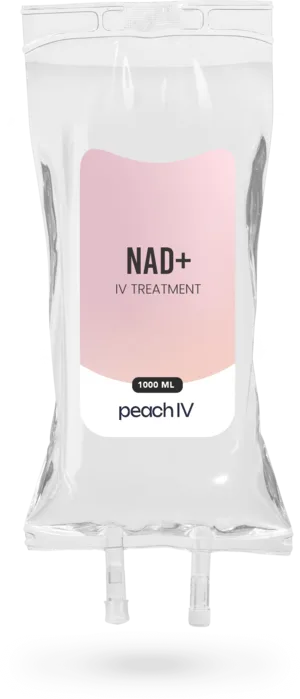
NAD+, from $495: 200mg, 500mg or 1000mg, brought to your home, hotel or office by a registered nurse. No travel fee. No service charge.
NAD+ and the brain: clarity and focus
Your brain is one of the body’s hungriest organs: it uses far more energy than its size suggests. That’s why NAD+ matters for mental energy too.
- Fueling brain cells. Like muscle cells, neurons rely on NAD+ for their energy. When neurons run short of ATP, it can show up as “brain fatigue”: trouble concentrating, remembering or forming clear ideas, the classic brain-fog feeling.
- The cell’s own maintenance. NAD+ switches on enzymes like sirtuins, which help cells handle stress. Animal research is looking at what that means for brain inflammation and brain function.
- Adapting and learning. Some early research looks at NAD+ and neuroplasticity, the brain’s ability to form new connections, which is central to learning.
That is why people dealing with brain fog, and professionals who want to stay focused through deep work, are exploring NAD+. Fatigue and mood often go hand in hand, too: when people feel rested and clear, it often shows in how they feel day to day. NAD+ isn’t a treatment for any mental health condition, depression included; if low mood is part of the picture, talk to your doctor.
Who is curious about NAD+ for energy?
NAD+ levels fall as we get older, so interest tends to grow with age. People often look into an NAD+ drip if they are:
- Busy professionals and students pushing through long hours. Some book a drip as a periodic reset during high-demand seasons at work, or around exams.
- Dealing with brain fog: those times when you just can’t think or focus the way you know you can.
- Getting older and wanting to look after their energy as NAD+ naturally declines.
It’s important to set realistic expectations. NAD+ is a complementary strategy, not a standalone fix for severe fatigue or any illness. Healthy habits (nutrition, sleep and exercise) remain the foundation of energy and brain health.
Does NAD+ IV therapy really work? The evidence
NAD+ IV therapy sounds promising, but what does the science say so far? The honest answer: the science is encouraging, and still emerging.
We have a solid understanding of NAD+ biology, and extensive research on raising NAD+ and cellular energy in animals, including studies in aging mice on brain function and muscle strength. Those are animal studies, though. Human data is more limited: small trials of NAD+ precursors in older adults, with trials of IV NAD+ underway that may shed more light.
Most of the evidence today comes from biochemistry, animal studies, and reports from patients and clinicians. Placebo and personal bias can play a role in how people feel, and some critics say the claims around NAD+ have run ahead of the evidence, which happens with anything that gets a lot of hype. NAD+ IV therapy is generally considered low-risk when it’s done safely under medical guidance, and individual experiences vary: some people notice a lot, others very little.
What to consider before trying NAD+
- Talk to a healthcare provider first. They can check whether an NAD+ IV is right for you, and screen for anything that rules out IVs in general.
- Quality and setting. Choose a reputable provider that uses medical-grade NAD+ and proper sterile technique, with a qualified nurse or doctor giving the IV and watching how you do. Avoid unsupervised drips.
- Time and cost. NAD+ is a costly compound and the drip is slow. Our NAD+ drips are $495 for 200mg, $695 for 500mg and $995 for 1000mg; you can also add 50mg ($195), 100mg ($295) or 200mg ($395) to any drip. For how people space sessions, see our NAD+ dosage guide. Some people also take NAD+ precursor supplements between sessions.
- Other add-ons. Any drip can also carry vitamins, like vitamin B12 (5mg, $25) or B-complex ($30).
The bottom line
An NAD+ infusion sits where modern science meets holistic wellness: a way to support energy at the level of your cells, backed by strong biology and still waiting on larger human studies. Staying well is a personal journey. NAD+ is one of the newer tools that may help along the way, especially when the basics are already in place. With an informed view and medical guidance, you can decide whether it belongs in yours.

With 10+ years of experience in the medical field, he designs and supervises protocols to keep care safe, consistent, and clinically grounded.