

New to NAD+? Start with our Beginner’s Guide to NAD+ for the full story.
Why it matters
Why should you care about NAD+ or NADH at all? These molecules are at the heart of how your body makes energy. NAD+ levels in our cells naturally decline as we get older, and that drop is linked to fatigue, a slower metabolism and other age-related changes.
The difference between the two explains how your cells turn nutrients into energy and keep working well. And as interest in raising NAD+ has boomed, the two names get mixed up all the time.
What is NAD+?
NAD (nicotinamide adenine dinucleotide) is a coenzyme found in every living cell: a helper molecule that makes vital reactions possible. When people say “NAD,” they usually mean NAD+, the form that carries a positive charge. Its main job is to help turn the food we eat into energy by shuttling electrons between molecules, and it takes part in hundreds of other processes, from cell repair to the sleep-wake cycle.
Think of NAD+ as an empty shuttle bus, ready to pick up passengers (energy, in the form of electrons) and carry them where they’re needed. Without enough NAD+, cells would struggle to make ATP, the energy we need to live.
What is NADH?
NADH is the reduced form of NAD+: the same molecule, now carrying energy in the form of electrons (and a hydrogen ion). In the shuttle picture, NADH is the bus full of passengers. It feeds those electrons into the last stage of energy production, the electron transport chain in your mitochondria, to make ATP. Once it drops off its cargo, it turns back into NAD+, and the cycle goes on.
The key differences
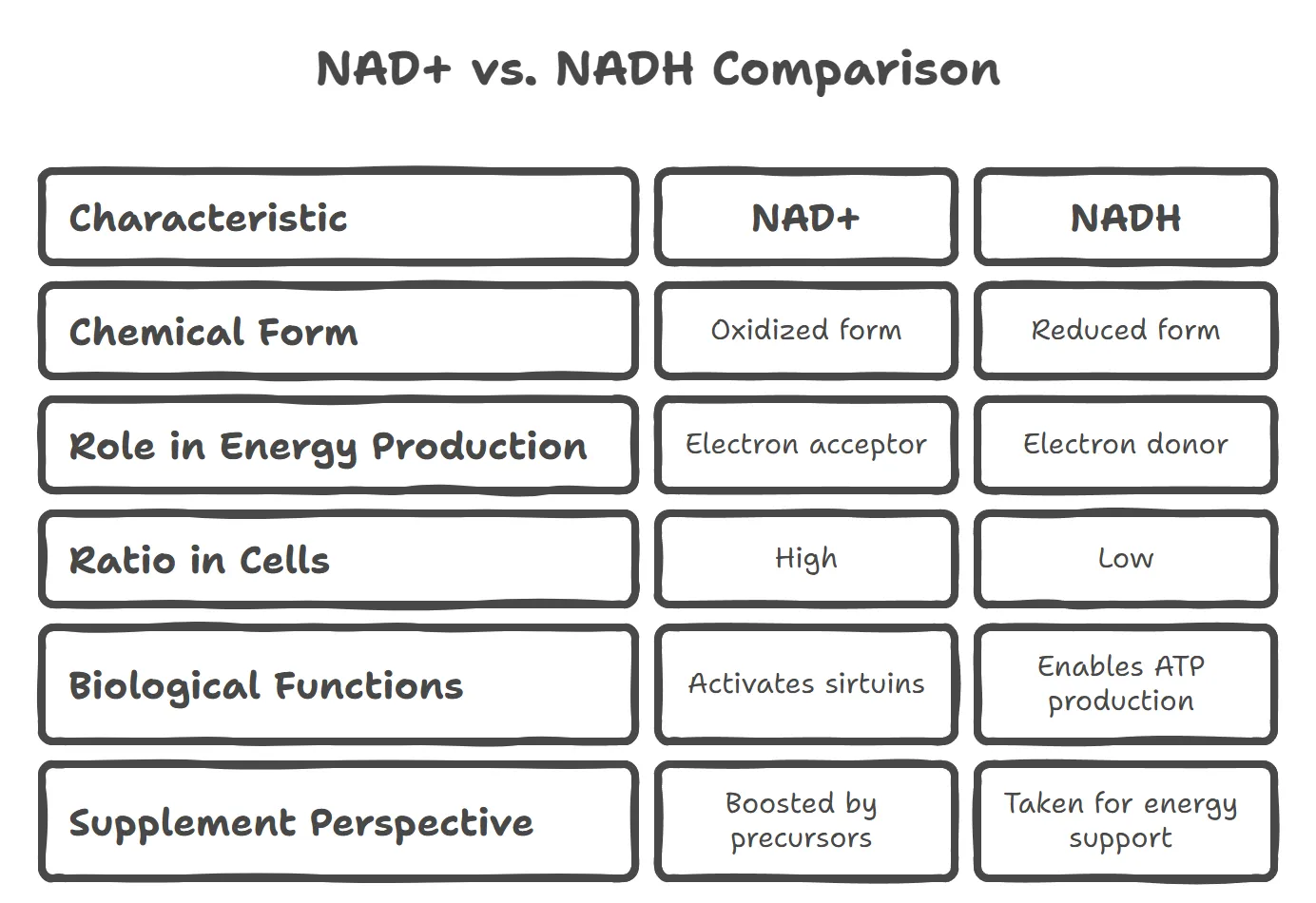
NAD+ and NADH turn into each other constantly inside your cells, but they differ clearly in form and in job.
- Chemical form. NAD+ is the oxidized form and carries a positive charge. NADH is the reduced form: it has picked up electrons and a hydrogen, which cancel the charge. That’s why one has a “+” and the other doesn’t.
- Role in energy. NAD+ is an electron acceptor, hungry for electrons. NADH is an electron donor, carrying them to the mitochondria, where they help make ATP. Put simply: NAD+ picks up fuel, NADH delivers it to the cell’s power stations.
- How much of each. In healthy cells, NAD+ far outnumbers NADH, roughly 700 to 1 in the cell’s fluid. That high ratio keeps metabolism running efficiently. When the balance shifts (too little NAD+, or too much NADH), cells make energy less well and metabolism slows.
- Other jobs. NAD+ is needed for energy and also helps in hundreds of other processes; for example, it switches on sirtuins, enzymes studied in aging research. NADH’s job is narrower: it delivers electrons, turning back into NAD+ as it does, and that directly makes ATP for your muscles, brain and organs.
- As supplements. NAD+ is usually raised indirectly, with precursors like NR or NMN that the body converts into NAD+. NADH is also sold as a supplement, usually for energy. Raising NAD+ in your cells naturally produces more NADH too, as part of the energy cycle.
That is why you see both names in health articles. They work as a pair: NAD+ becomes NADH when it is charged with energy, and NADH becomes NAD+ again once it has released it.
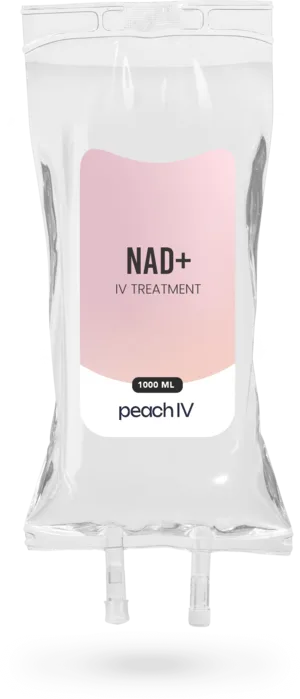
NAD+, from $495: 200mg, 500mg or 1000mg, brought to your home, hotel or office by a registered nurse. No travel fee. No service charge.
The bottom line
NAD+ and NADH sound like technical biochemistry, but they are the duo behind your cells’ energy. NAD+ is the helper that makes hundreds of processes possible, from energy production to cell repair; NADH is the carrier that delivers the power. Most supplements and wellness routines focus on topping up NAD+. Curious how much, and how often? Read our NAD+ dosage guide.

With 10+ years of experience in the medical field, he designs and supervises protocols to keep care safe, consistent, and clinically grounded.