

As we age, our skin’s natural ability to repair damage and renew itself slows down, which shows up as wrinkles, spots and slower healing. Scientists have found that NAD+ plays a role in many of these processes. Here is what NAD+ does in theory, and how much of that applies to real-life skin.
New to NAD+? Read our Beginner’s Guide to NAD+ first for the basics.
1. Sun exposure and the cell’s repair work
Every day, your skin takes ultraviolet (UV) rays from sunlight, plus other environmental stressors that can harm cells. Enzymes called PARPs respond to that UV damage inside skin cells, and they use up NAD+ as fuel when they do.
That is why researchers are interested in NAD+ and sun-exposed skin. It doesn’t undo sun damage, and it’s no substitute for protection: we always recommend sunscreen before anything else.
2. Collagen and firmness
Collagen is the protein that gives skin its firmness and elasticity. As we age, collagen production slows, and skin becomes thinner and less elastic.
NAD+ powers sirtuins (especially SIRT1 and SIRT6), proteins involved in keeping tissues firm. When NAD+ levels drop with age, sirtuins become less active. Research indicates that older skin has lower NAD+ and lower sirtuin activity. Lab experiments are looking at whether replenishing NAD+ supports the cells that make collagen; it’s too early to say what that means for wrinkles.
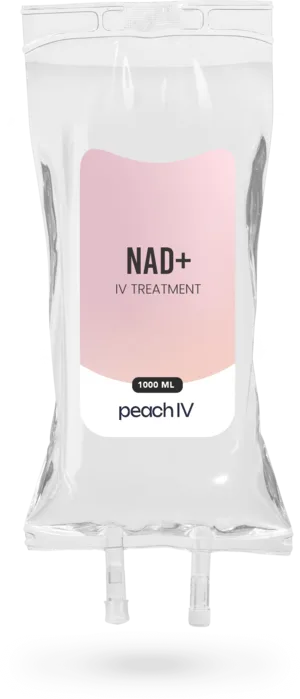
NAD+, from $495: 200mg, 500mg or 1000mg, brought to your home, hotel or office by a registered nurse. No travel fee. No service charge.
3. Skin cell renewal
Ever had a cut and thought, “I must be getting old, this is taking ages to heal”? Your skin is constantly renewing itself, shedding and replacing millions of cells a day, and the stem cells in your skin work tirelessly to supply new ones. Those cells need energy, and NAD+ is part of how they make it.
In studies of older animals, NAD+ precursors have been studied for wound healing and skin renewal. Those are animal studies; research in people is still to come.
4. Inflammation and the skin barrier
NAD+ is involved in the cell pathways that regulate the immune and inflammatory response, and in processes that keep the skin barrier, which holds in moisture and keeps out irritants, working.
Researchers are studying NAD+ and skin inflammation, including in conditions like psoriasis. That research is still preliminary, and NAD+ isn’t a treatment for any skin condition. If you live with eczema, psoriasis or ongoing redness, see a dermatologist.
Be realistic
NAD+ is an interesting area of skin research, but it isn’t a skin treatment, and it won’t make sweeping changes to your complexion. Any difference would be subtle and slow, and nobody can promise one. Think of supporting NAD+ as a complement to a good skincare routine, never a replacement for it.
The basics still matter most: sunscreen every day, moisturizer, products with proven ingredients such as niacinamide or antioxidants, a diet rich in vitamin B3 and protein, exercise and good sleep. If you’re curious about NAD+ itself, our NAD+ drip brings it to your home, and you can read NAD+ safety and side effects first.

With 10+ years of experience in the medical field, he designs and supervises protocols to keep care safe, consistent, and clinically grounded.